This page refers to general accessibility at Temporary Tactile workshops. For specific information about an upcoming event or venue, visit our Upcoming Events page.
Languages:
Facilitation (workshop descriptions and demonstrations) will be in English. At all workshops, additional language printed resources are available in English, French, Spanish, Traditional Chinese, Punjabi (Gurmukhi), Korean (Hanjul) and UEB Braille.
ASL instructions for the workshop are available via a QR code or through conversation with Kay, one of the artist facilitators. We will have ASL interpretation at the September 5 event.
Spoken languages other than English: Mandarin will be coordinated by Johnny. Spanish will be coordinated by Keimi. French will be coordinated by Kay.
Workshop Materials:
The workshop will involve handling metal, plastic, paper, or fabric. The primary material used is a thin aluminum sheet of metal that has been machine cut. However, participants are asked to take care when handling the metal as it can be sharp on the edges, like a piece of paper.
We also provide other recycled metal containers, such as pie plates with a rounded, folded edge. These materials may shift or rub together, making a clanking or rattling sound.
A synthetic rubber mat will be used under the metal so that depressions in the surface are made without ripping the materials or digging into the table beneath.
A variety of mark-making or impression-making tools will be available. These include wooden chopsticks, modified stainless steel cutlery, bent and cut plastic toothbrush handles, and push pins. Some grip strength is required to handle the tools.
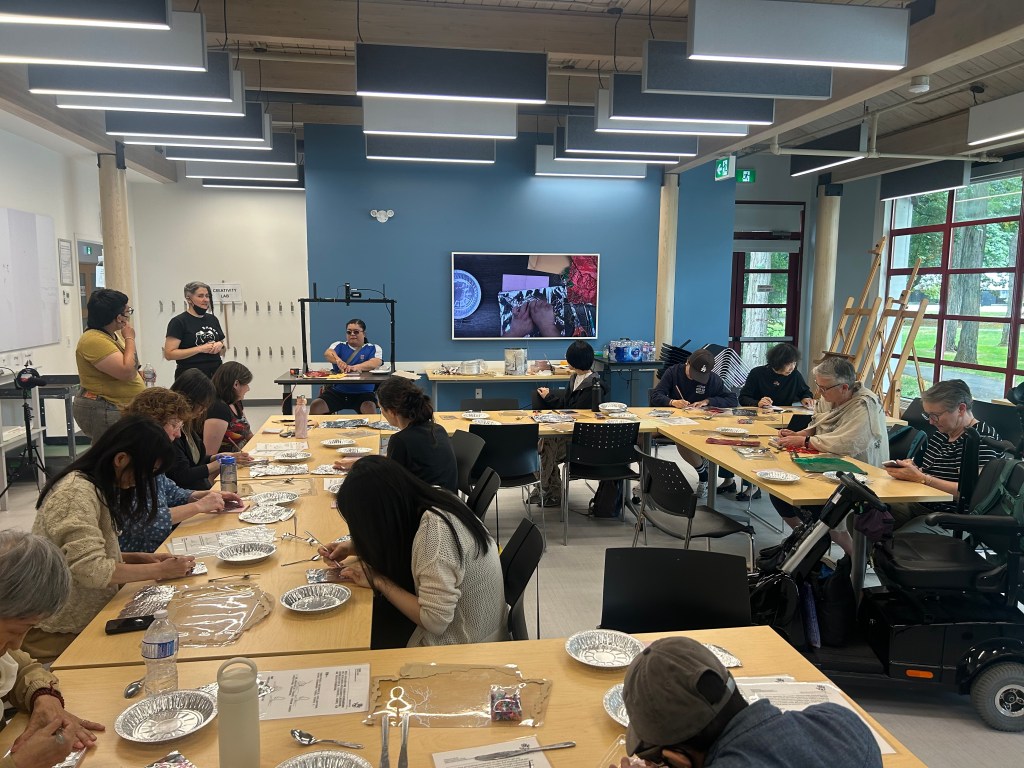
Image Description: Inside at the Richmond Cultural Annex, tables are set up with participants facing each other. They work on flat pieces of aluminum, the tables covered in tools and mark-making materials. At one end of the room, Johnny sits at a table under a suspended camera which relays his drawing surface to a wall mounted TV behind him. To one side, Kay and Keimi stand and describe his motions.
Masks:
Masks are an essential safety tool for many people throughout the year. When our workshops are outside, we take care to leave space for people to sit where they feel safe, and to make spaces that allow for mask-wearing participants to be distanced from non-mask wearing participants.
We acknowledge that masks are required for the safety and health of many of our community members.
We acknowledge that masks can also be an access barrier for lip reading, signed language grammar, or for many sensory reasons.
We will do our best to support a hybrid mask-positive space, but acknowledge that in public spaces without registration, and while welcoming drop-in participation, we cannot guarantee a mask-mandatory environment.
 Temporary Tactile